This Office Memorandum details the procedure for procuring summer/winter uniforms for Group ‘C’ and erstwhile Group ‘D’ employees working in Non-Statutory Departmental Canteens. It references previous Ministry of Finance guidelines and clarifies that all purchases must now adhere to the General Financial Rules (GFRs) 2005, including the use of Purchase Committees and adherence to specified rules regarding tenders and quotations. The document also outlines the specific types and quantities of uniforms authorized for different canteen employee categories (Bearers, Halwais, Dish Cleaners, Sweepers) and provides details on winter clothing allowances for all categories and turbans for Sikh employees. It emphasizes transparency, competition, and accountability in the procurement process.
SOURCE PDF LINK :
Click to access 18-1-2009-DirC-27-8-2010.pdf
Click to view full document content
No.18/1/2009-Dir.(C)
Government of India
Ministry of Personnel, P.G. and Pensions
(Department of Personnel and Training)
Lok Nayak Bhawan, Khan Market,
New Delhi, dated 27th August, 2010
OFFICE MEMORANDUM
Subject: Procurement of Uniforms (Summer/Winter) for employees of Non-Statutory Departmental Canteens/Tiffin Rooms located in Central Govt. Offices – regarding.
Reference Ministry of Finance O.M. No.1/12/E.II(A)/94, dated 29.7.2005.
- Consequent to the coming into force of the new General Financial Rules, 2005 (GFRs), it has become necessary to review and modify the existing procedure for procurement/purchase of summer/winter uniforms’ for Group ‘C’ and erstwhile Group ‘D’ employees serving in the Non-Statutory Departmental Canteens so as to bring it in the line with the provisions of the revised GFRs. In this connection, it is also mentioned that the Ministry of Finance (Department of Expenditure) vide O.M. dated 29.7.2005 has clarified that the special dispensation from the process of inviting tenders/quotations provided to NCCF/Kendriya Bhandar in DOPT Welfare Division’s O.M. dated 14.7.1981 and 11.4.1994 under Chapter 8 of the old GFRs no longer holds good and that purchase/procurement of goods by Government of India Offices will now be solely guided by the provisions of GFRs 2005.
-
Accordingly, it has been decided to allow the concerned Administration of the canteen service to procure uniforms/liveries for the employees of Non-Statutory Departmental Canteens by following the Purchase Procedure as mentioned in the relevant rules of the GFRs 2005, which are also outlined below:
……2/-
(i) Chapter 6 of the GFR’s 2005 pertaining to Procurement of Goods and Services may be carefully perused to ensure that the procurement/purchase procedure adopted is strictly in line with the prescribed rules. In this connection attention is also drawn to some of the following important provisions, details of which may be obtained from GFR’s 2005 :-
Rule 137 – Fundamental Principles of Public Buying
Rule 144 -Reserved items
Rule 145 – Purchase of Goods without Quotation
Rule 146 – Purchase of Goods by Purchase Committee
Rule 148 – Demand should not be divided into small quantities to make price-meal purchase
Rule 160 – Transparency, competition, fairness and elimination of Arbitrariness
Rule 161 – Efficiency, Economy and Accountability in Public Procurement System
(ii) All purchase should be made through a duly constituted Purchase Committee comprising of three members of an appropriate level as decided by the Head of the Department, including one member from the Internal Finance Division and two belonging to the Administration Division. In addition, a fourth member may be associated with the Purchase Committee, to be nominated by the concerned canteen staff Associations/Unions.
4. The list of items as admissible to the canteen employees is Annexed. An Office Memorandum issued by DOPT vide O.M. No. 14/7/2003-JCA, dated 21.11.2005 ‘on procurement of uniforms (summer/winter) for common categories of employees in the Central Government Ministries/Departments – revised procedure under the General Financial Rules, 2005 is also attached for facilitation of reference.
5. Hindi version of this O.M. will follow.
Encls : As above.

(Rajiv Manjhi)
Director(Canteens)
To :
- All Ministries/Departments of the Government of India. (Director/Deputy Secretaries Incharge, Administrative Division/Wing, as per standard list).
- President’s Secretariat, Rashtrapati Bhawan, New Delhi.
- Vice-President’s Secretariat, Maulana Azad Road, New Delhi.
- Cabinet Secretariat, New Delhi.
- Deputy Secretary(Admn.), DOPT, North Block, New Delhi.
- Comptroller & Auditor General of India, New Delhi.
- Director of Audit, Central Revenue, New Delhi.
- Controller General of Accounts, Ministry of Finance, New Delhi.
- Supreme Court of India, Tilak Marg, New Delhi.
- Controller General of Defence Accounts, R.K. Puram, West Block, New Delhi.
- CAO’s Office, Ministry of Defence, DHQ, PO, New Delhi-110011.
- Administrator, all Union Territories as per standard list.
- Tech. Dir. (NIC), Room No. 381, Lok Nayak Bhawan, New Delhi.
- Section Officer (Canteens) with 30 spare copies.
INMEDIATE
Government of India
Ministry of Personnel Public Grievances and Pensions
Department of Personnel and Training
North Block, New Delhi
No.14/7/2003-JCA
Dated the $21^{\text {n }}$ November, 2005
OFFICE MEMORANDUM
Subject:- Procurement of uniforms (summer/winter) for common categories of employees in the Central Government Ministries/Departments- revised procedure under the General Financial Rules, 2005 – reg.
Reference: Ministry of Finance OM No.1/12/E.II(A)/94 dated 29-7-2005
The undersigned is directed to refer to the consolidated instructions issued in this Department OM No. 14/8/90-JCA dated 29.6.1990 and further orders issued from time to time dealing with the procedure for procurement and supply of summer/winter uniforms to common categories of Group ‘C’ and ‘D’ employees serving in various Ministries/ Departments of the Central Government and to say as follows.
2. Consequent to the coming into force of the new General Financial Rules, 2005 (GFRs), it has become necessary to review and modify the existing procedure for procurement/purchase of summer/winter uniforms’ for common categories of Group ‘C’ and ‘D’ employees serving in various Ministries/ Departments of the Central Government so as to bring it in line with the provisions of the revised GFRs. In this connection, it is also relevant to note that vide OM dated 29-7-2005 cited above, the Ministry of Finance (Department of Expenditure) has clarified that the special dispensation from the process of inviting tenders/quotations provided to NCCF/Kendriya Bhandar in DOPT Welfare Division’s OM dated 14.7.1981and 11.4.1994 under Chapter 8 of the old GFRs no longer holds good and that purchase/procurement of goods by Government of India offices will now be solely guided by the provisions of GFRs 2005.
3. In the circumstances, in supersession of the extant instructions regarding procurement of summer/winter uniforms relating to Groups ‘ $C$ ‘ & ‘ $D$ ‘ employees in the Central Secretariat Ministries/ Departments and its attached and subordinate offices, the purchase procedure to be followed in different exigencies and the relevant rules in the GFRs are outlined below:-
(i) Chapter 6 of the GFR’s 2005 pertaining to Procurement of Goods and Services may be carefully perused to ensure that the procurement/purchase procedure adopted is strictly in line with the prescribed rules. In this connection attention is specially drawn to some of the following important provisions, details of which may be obtained from the GFR’s 2005:-
Rule 137 – Fundamental Principles of Public Buying
Rule 144 – Reserved items
Rule 145 – Purchase of Goods without Quotation
Rule 146 – Purchase of Goods by Purchase Committee
Rule 148 – Demand should not be divided into small quantities to make pricemeal purchase
Rule 160 – Transparency, competition, fairness and elimination of Arbitrariness in the procurement process
Rule 161 – Efficiency, Economy and Accountability in Public Procurement System
-2-
(ii) All purchases should be made through a duly constituted Purchase Committee comprising of three members of an appropriate level as decided by the Head of the Department, including one member from the Internal Finance Division and two belonging to the Administration Division. In addition, a fourth member may be associated with the Purchase Committee, to be nominated by the concerned staff Associations / unions.
(iii) In case of purchase of goods of a value above Rs.15,000/- and upto Rs.1,00,000/-, on each occasion, purchase may be made only on the recommendation of a duly constituted Purchase Committee defined in para (ii) above, and as decided by the Head of the Department. The Committee will survey the market to ascertain the reasonableness of rate, quality and specifications and identify the appropriate supplier. Also, before placing the purchase order, the members of the Committee will jointly record a certificate and authenticate it, as under:
“Certified that we, S/Shri, members of the purchase committee, are jointly and individually satisfied that the goods recommended for purchase are of the requisite specification and quality, priced at the prevailing market rate and the supplier recommended is reliable and competent to supply the goods in question.”
(iv) Subject to the exceptions incorporated in Rules 151 and 154 of GFR’s, 2005, invitation to tenders by advertisement should be used for procurement of goods of estimated value of Rs.25 lakhs and above.
(v) In case the Ministry / Department directly procures DGS&D rate contract goods from suppliers, the prices to be paid for such goods should not exceed the rates mentioned in the rate contract and the other terms and conditions of purchase should also be in line with those specified in the rate contract. In addition, the Ministry/Department has to make its own arrangement for inspection and testing of the goods, where so required.
- While observing the above change in procedure, the Purchase Committee / Competent Authority may also keep in view the provisions of Rule 144 of the GFRs, 2005, that reads as under:-
“Rule 144. Reserved Items: The Central Government, through administrative instructions, has reserved all items of handspun and hand-woven textiles (Khadi goods) for exclusive purchase from Khadi Village Industries Commission (KVIC), it has also reserved all items of handloom textiles required by Central Government departments for exclusive purchase from KVIC and / or the notified handlooms units of ACASH (Association of Corporations and Apex Societies of Handlooms). The Central Government has also reserved some items for purchase from registered Small Scale Industrial Units. The Central Departments or Ministries are to make their purchases for such reserved goods and items from such units as per the instructions issued by the Central Government in this regard.”
Hindi version will follow.
R. Vaidyanathan
Under Secretary to the Govt. of India
To
All Ministries/ Departments of the Government of India.
CHAPTER – 6
PROCUREMENT OF GOODS AND SERVICES
I. PROCUREMENT OF GOODS
Rule 135. This chapter contains the general rules applicable to all Ministries or Departments, regarding procurement of goods required for use in the public service. Detailed instructions relating to procurement of goods may be issued by the procuring departments broadly in conformity with the general rules contained in this Chapter.
Rule 136. Definition of Goods : The term ‘goods’ used in this chapter includes all articles, material, commodities, livestock, furniture, fixtures, raw material, spares, instruments, machinery, equipment, industrial plant etc. purchased or otherwise acquired for the use of Government but excludes books, publications, periodicals, etc. for a library.
Rule 137. Fundamental principles of public buying : Every authority delegated with the financial powers of procuring goods in public interest shall have the responsibility and accountability to bring efficiency, economy, transparency in matters relating to public procurement and for fair and equitable treatment of suppliers and promotion of competition in public procurement.
The procedure to be followed in making public procurement must conform to the following yardsticks :-
(i) the specifications in terms of quality, type etc., as also quantity of goods to be procured, should be clearly spelt out keeping in view the specific needs of the procuring organisations. The specifications so worked out should meet the basic needs of the organisation without including superfluous and non-essential features, which may result in unwarranted expenditure. Care should also be taken to avoid purchasing quantities in excess of requirement to avoid inventory carrying costs;
(ii) offers should be invited following a fair, transparent and reasonable procedure;
(iii) the procuring authority should be satisfied that the selected offer adequately meets the requirement in all respects;
(iv) the procuring authority should satisfy itself that the price of the selected offer is reasonable and consistent with the quality required;
(v) at each stage of procurement the concerned procuring authority must place on record, in precise terms, the considerations which weighed with it while taking the procurement decision.
Rule 138. Authorities competent to purchase goods: An authority which is competent to incur contingent expenditure may sanction the purchase of goods required for use in public service in accordance with Schedule V of the Delegation of Financial Powers Rules, 1978, following the general procedure contained in the following rules.
Rule 139. Procurement of goods required on mobilisation: Procurement of goods required on mobilisation and/or during the continuance of Military operations shall be regulated by special rules and orders issued by the Government on this behalf from time to time.
Rule 140. Powers for procurement of goods: The Ministries or Departments have been delegated full powers to make their own arrangements for procurement of goods. In case however, a Ministry or Department does not have the required expertise, it may project its indent to the Central Purchase Organisation (e.g. DGS&D) with the approval of competent authority. The indent form to be utilised for this purpose will be as per the standard form evolved by the Central Purchase Organisation.
Rule 141. Rate Contract: The Central Purchase Organisation (e.g. DGS&D) shall conclude rate contracts with the registered suppliers, for goods and items of standard types, which are identified as common user items and are needed on recurring basis by various Central Government Ministries or Departments. Definition of Registered suppliers is given in Rule 142 below. The Central Purchase Organisation will furnish and update all the relevant details of the rate contracts in its web site. The Ministries or Departments shall follow those rate contracts to the maximum extent possible.
Rule 142. Registration of Suppliers:
(i) With a view to establishing reliable sources for procurement of goods commonly required for Government use, the Central Purchase Organisation (e.g. DGS&D) will prepare and maintain item-wise lists of eligible and capable suppliers. Such approved suppliers will be known as “Registered Suppliers”. All Ministries or Departments may utilise these lists as and when necessary. Such registered suppliers are prima facie eligible for consideration for procurement of goods through Limited Tender Enquiry. They are also ordinarily exempted from furnishing bid security along with their bids. A Head of Department may also register suppliers of goods which are specifically required by that Department or Office.
(ii) Credentials, manufacturing capability, quality control systems, past performance, after-sales service, financial background etc. of the supplier(s) should be carefully verified before registration.
(iii) The supplier(s) will be registered for a fixed period (between 1 to 3 years) depending on the nature of the goods. At the end of this period, the registered supplier(s) willing to continue with registration are to apply
afresh for renewal of registration. New supplier(s) may also be considered for registration at any time, provided they fulfil all the required conditions.
(iv) Performance and conduct of every registered supplier is to be watched by the concerned Ministry or Department. The registered supplier(s) are liable to be removed from the list of approved suppliers if they fail to abide by the terms and conditions of the registration or fail to supply the goods on time or supply substandard goods or make any false declaration to any Government agency or for any ground which, in the opinion of the Government, is not in public interest.
Rule 143. Enlistment of Indian Agents : As per the Compulsory Enlistment Scheme of the Department of Expenditure, Ministry of Finance, it is compulsory for Indian agents, who desire to quote directly on behalf of their foreign principals, to get themselves enlisted with the Central Purchase Organisation (eg. DGS&D). However, such enlistment is not equivalent to registration of suppliers as mentioned under Rule 142 above.
Rule 144. Reserved Items : The Central Government, through administrative instructions, has reserved all items of handspun and handwoven textiles (khadi goods) for exclusive purchase from Khadi Village Industries Commission (KVIC). It has also reserved all items of handloom textiles required by Central Government departments for exclusive purchase from KVIC and/or the notified handloom units of ACASH (Association of Corporations and Apex Societies of Handlooms). The Central Government has also reserved some items for purchase from registered Small Scale Industrial Units. The Central Departments or Ministries are to make their purchases for such reserved goods and items from such units as per the instructions issued by the Central Government in this regard.
Rule 145. Purchase of goods without quotation : Purchase of goods upto the value of Rs. 15,000/- (Rupees Fifteen Thousand) only on each occasion may be made without inviting quotations or bids on the basis of a certificate to be recorded by the competent authority in the following format.
“I, $\qquad$ , am personally satisfied that these goods purchased are of the requisite quality and specification and have been purchased from a reliable supplier at a reasonable price.”
Rule 146. Purchase of goods by purchase committee : Purchase of goods costing above Rs. 15,000/- (Rupees Fifteen Thousand) only and upto Rs. 1,00,000/- (Rupees One lakh) only on each occasion may be made on the recommendations of a duly constituted Local Purchase Committee consisting of three members of an appropriate level as decided by the Head of the Department. The committee will survey the market to ascertain the reasonableness of rate, quality and specifications and identify the appropriate
supplier. Before recommending placement of the purchase order, the members of the committee will jointly record a certificate as under.
“Certified that we $\qquad$ , members of the purchase committee are jointly and individually satisfied that the goods recommended for purchase are of the requisite specification and quality, priced at the prevailing market rate and the supplier recommended is reliable and competent to supply the goods in question. ”
Rule 147. Purchase of goods directly under rate contract :
(1) In case a Ministry or Department directly procures Central Purchase Organisation (e.g. DGS&D) rate contracted goods from suppliers, the prices to be paid for such goods shall not exceed those stipulated in the rate contract and the other salient terms and conditions of the purchase should be in line with those specified in the rate contract. The Ministry or Department shall make its own arrangement for inspection and testing of such goods where required.
(2) The Central Purchase Organisation (e.g. DGS\&D) should host the specifications, prices and other salient details of different rate contracted items, appropriately updated, on the web site for use by the procuring Ministry or Department.
Rule 148. A demand for goods should not be divided into small quantities to make piece meal purchases to avoid the necessity of obtaining the sanction of higher authority required with reference to the estimated value of the total demand.
Rule 149. Purchase of goods by obtaining bids: Except in cases covered under Rule 145, 146 and 147(1), Ministries or Departments shall procure goods under the powers referred to in Rule 140 above by following the standard method of obtaining bids in :
(i) Advertised Tender Enquiry;
(ii) Limited Tender Enquiry;
(iii) Single Tender Enquiry.
Rule 150. Advertised Tender Enquiry.
(i) Subject to exceptions incorporated under Rules 151 and 154, invitation to tenders by advertisement should be used for procurement of goods of estimated value Rs. 25 lakh (Rupees Twenty Five Lakh) and above. Advertisement in such case should be given in the Indian Trade Journal (ITJ), published by the Director General of Commercial Intelligence and Statistics, Kolkata and at least in one national daily having wide circulation.
(ii) An organisation having its own web site should also publish all its advertised tender enquiries on the web site and provide a link with NIC
web site. It should also give its web site address in the advertisements in ITJ and newspapers.
(iii) The organisation should also post the complete bidding document in its web site and permit prospective bidders to make use of the document downloaded from the web site. If such a downloaded bidding document is priced, there should be clear instructions for the bidder to pay the amount by demand draft etc. along with the bid.
(iv) Where the Ministry or Department feels that the goods of the required quality, specifications etc., may not be available in the country and it is necessary to also look for suitable competitive offers from abroad, the Ministry or Department may send copies of the tender notice to the Indian embassies abroad as well as to the foreign embassies in India. The selection of the embassies will depend on the possibility of availability of the required goods in such countries.
(v) Ordinarily, the minimum time to be allowed for submission of bids should be three weeks from the date of publication of the tender notice or availability of the bidding document for sale, whichever is later. Where the department also contemplates obtaining bids from abroad, the minimum period should be kept as four weeks for both domestic and foreign bidders.
Rule 151. Limited Tender Enquiry.
(i) This method may be adopted when estimated value of the goods to be procured is up to Rupees Twenty-five Lakhs. Copies of the bidding document should be sent directly by speed post/registered post/courier/e-mail to firms which are borne on the list of registered suppliers for the goods in question as referred under Rule 142 above. The number of supplier firms in Limited Tender Enquiry should be more than three. Further, web based publicity should be given for limited tenders, Efforts should be made to identify a higher number of approved suppliers to obtain more responsive bids on competitive basis.
(ii) Purchase through Limited Tender Enquiry may be adopted even where the estimated value of the procurement is more than Rupees twentyfive Lakhs, in the following circumstances.
(a) The competent authority in the Ministry or Department certifies that the demand is urgent and any additional expenditure involved by not procuring through advertised tender enquiry is justified in view of urgency. The Ministry or Department should also put on record the nature of the urgency and reasons why the procurement could not be anticipated.
(b) There are sufficient reasons, to be recorded in writing by the competent authority, indicating that it will not be in public interest to procure the goods through advertised tender enquiry.
(c) The sources of supply are definitely known and possibility of fresh source(s) beyond those being tapped, is remote.
(iii) Sufficient time should be allowed for submission of bids in Limited Tender Enquiry cases.
Rule 152. Two bid system : For purchasing high value plant, machinery etc. of a complex and technical nature, bids may be obtained in two parts as under :-
(a) Technical bid consisting of all technical details alongwith commercial terms and conditions; and
(b) Financial bid indicating item-wise price for the items mentioned in the technical bid.
The technical bid and the financial bid should be sealed by the bidder in separate covers duly superscribed and both these sealed covers are to be put in a bigger cover which should also be sealed and duly superscribed. The technical bids are to be opened by the purchasing Ministry or Department at the first instance and evaluated by a competent committee or authority. At the second stage financial bids of only the technically acceptable offers should be opened for further evaluation and ranking before awarding the contract.
Rule 153. Late Bids : In the case of advertised tender enquiry or limited tender enquiry, late bids (i.e. bids received after the specified date and time for receipt of bids) should not be considered.
Rule 154. Single Tender Enquiry.
Procurement from a single source may be resorted to in the following circumstances :
(i) It is in the knowledge of the user department that only a particular firm is the manufacturer of the required goods.
(ii) In a case of emergency, the required goods are necessarily to be purchased from a particular source and the reason for such decision is to be recorded and approval of competent authority obtained.
(iii) For standardisation of machinery or spare parts to be compatible to the existing sets of equipment (on the advice of a competent technical expert and approved by the competent authority), the required item is to be purchased only from a selected firm.
Note : Proprietary Article Certificate in the following form is to be provided by the Ministry / Department before procuring the goods from a single source under the provision of sub Rule 154 (i) and 154 (iii) as applicable.
‘(i) The indented goods are manufactured by $\mathrm{M} / \mathrm{s}$ $\qquad$
(ii) No other make or model is acceptable for the following reasons :
$\qquad$
$\qquad$
(iii) Concurrence of finance wing to the proposal vide :
(iv) Approval of the competent authority vide
(Signature with date and designation of the procuring officer)’
Rule 155. Contents of Bidding Document : All the terms, conditions, stipulations and information to be incorporated in the bidding document are to be shown in the appropriate chapters as below :-
Chapter – 1 : Instructions to Bidders.
Chapter – 2 : Conditions of Contract.
Chapter – 3 : Schedule of Requirements.
Chapter – 4 : Specifications and allied Technical Details.
Chapter – 5 : Price Schedule(to be utilised by the bidders for quoting their prices).
Chapter – 6 : Contract Form.
Chapter – 7 : Other Standard Forms, if any, to be utilised by the purchaser and the bidders.
Rule 156. Maintenance Contract : Depending on the cost and nature of the goods to be purchased, it may also be necessary to enter into maintenance contract(s) of suitable period either with the supplier of the goods or with any other competent firm, not necessarily the supplier of the subject goods. Such maintenance contracts are especially needed for sophisticated and costly equipment and machinery. It may however be kept in mind that the equipment or machinery is maintained free of charge by the supplier during its warranty period or such other extended periods as the contract terms may provide and the paid maintenance should commence only thereafter.
Rule 157. Bid Security :
(i) To safeguard against a bidder’s withdrawing or altering its bid during the bid validity period in the case of advertised or limited tender enquiry, Bid Security (also known as Earnest Money) is to be obtained from the bidders except those who are registered with the Central Purchase Organisation, National Small Industries Corporation (NSIC) or the concerned Ministry or Department. The bidders should be asked to furnish bid security along with their bids. Amount of bid security should ordinarily range between two percent to five percent of the estimated value of the goods to be procured. The exact amount of bid security, should be determined accordingly by the Ministry or Department and indicated in the bidding documents. The bid security may be accepted in the form of Account Payee Demand Draft, Fixed Deposit Receipt, Banker’s Cheque or Bank Guarantee from any of the commercial banks in an acceptable form, safeguarding the purchaser’s interest in all
respects. The bid security is normally to remain valid for a period of forty-five days beyond the final bid validity period.
(ii) Bid securities of the unsuccessful bidders should be returned to them at the earliest after expiry of the final bid validity and latest on or before the $30^{\text {th }}$ day after the award of the contract.
Rule 158. Performance Security :
(i) To ensure due performance of the contract, Performance Security is to be obtained from the successful bidder awarded the contract. Performance Security is to be obtained from every successful bidder irrespective of its registration status etc. Performance Security should be for an amount of five to ten per cent. of the value of the contract. Performance Security may be furnished in the form of an Account payee Demand Draft, Fixed Deposit Receipt from a Commercial bank, Bank Guarantee from a Commercial bank in an acceptable form safeguarding the purchasers interest in all respects.
(ii) Performance Security should remain valid for a period of sixty days beyond the date of completion of all contractual obligations of the supplier including warranty obligations.
(iii) Bid security should be refunded to the successful bidder on receipt of Performance Security.
Rule 159.
Advance payment to supplier : Ordinarily, payments for services rendered or supplies made should be released only after the services have been rendered or supplies made. However, it may become necessary to make advance payments in the following types of cases :-
(i) Advance payment demanded by firms holding maintenance contracts for servicing of Air-conditioners, computers, other costly equipment, etc.
(ii) Advance payment demanded by firms against fabrication contracts, turn-key contracts etc.
Such advance payments should not exceed the following limits :
(i) Thirty per cent. of the contract value to private firms;
(ii) Forty per cent. of the contract value to a State or Central Government agency or a Public Sector Undertaking; or
(iii) in case of maintenance contract, the amount should not exceed the amount payable for six months under the contract.
Ministries or Departments of the Central Government may relax, in consultation with their Financial Advisers concerned, the ceilings (including percentage laid down for advance payment for private
firms) mentioned above. While making any advance payment as above, adequate safeguards in the form of bank guarantee etc. should be obtained from the firm.
(2) Part payment to suppliers : Depending on the terms of delivery incorporated in a contract, part payment to the supplier may be released after it despatches the goods from its premises in terms of the contract.
Rule 160. Transparency, competition, fairness and elimination of arbitrariness in the procurement process : All government purchases should be made in a transparent, competitive and fair manner, to secure best value for money. This will also enable the prospective bidders to formulate and send their competitive bids with confidence. Some of the measures for ensuring the above are as follows:-
(i) the text of the bidding document should be self-contained and comprehensive without any ambiguities. All essential information, which a bidder needs for sending responsive bid, should be clearly spelt out in the bidding document in simple language. The bidding document should contain, inter alia;
(a) the criteria for eligibility and qualifications to be met by the bidders such as minimum level of experience, past performance, technical capability, manufacturing facilities and financial position etc.;
(b) eligibility criteria for goods indicating any legal restrictions or conditions about the origin of goods etc which may required to be met by the successful bidder;
(c) the procedure as well as date, time and place for sending the bids;
(d) date, time and place of opening of the bid;
(e) terms of delivery;
(f) special terms affecting performance, if any.
(ii) Suitable provision should be kept in the bidding document to enable a bidder to question the bidding conditions, bidding process and/ or rejection of its bid.
(iii) Suitable provision for settlement of disputes, if any, emanating from the resultant contract, should be kept in the bidding document.
(iv) The bidding document should indicate clearly that the resultant contract will be interpreted under Indian Laws.
(v) The bidders should be given reasonable time to send their bids.
(vi) The bids should be opened in public and authorised representatives of the bidders should be permitted to attend the bid opening.
(vii) The specifications of the required goods should be clearly stated without any ambiguity so that the prospective bidders can send meaningful bids. In order to attract sufficient number of bidders, the
specification should be broad based to the extent feasible. Efforts should also be made to use standard specifications which are widely known to the industry.
(viii) Pre-bid conference : In case of turn-key contract(s) or contract(s) of special nature for procurement of sophisticated and costly equipment, a suitable provision is to be kept in the bidding documents for a pre-bid conference for clarifying issues and clearing doubts, if any, about the specifications and other allied technical details of the plant, equipment and machinery projected in the bidding document. The date, time and place of pre-bid conference should be indicated in the bidding document. This date should be sufficiently ahead of bid opening date.
(ix) Criteria for determining responsiveness of bids, criteria as well as factors to be taken into account for evaluating the bids on a common platform and the criteria for awarding the contract to the responsive lowest bidder should be clearly indicated in the bidding documents.
(x) Bids received should be evaluated in terms of the conditions already incorporated in the bidding documents; no new condition which was not incorporated in the bidding documents should be brought in for evaluation of the bids. Determination of a bid’s responsiveness should be based on the contents of the bid itself without recourse to extrinsic evidence.
(xi) Bidders should not be permitted to alter or modify their bids after expiry of the deadline for receipt of bids.
(xii) Negotiation with bidders after bid opening must be severely discouraged. However, in exceptional circumstances where price negotiation against an ad-hoc procurement is necessary due to some unavoidable circumstances, the same may be resorted to only with the lowest evaluated responsive bidder.
(xiii) In the rate contract system, where a number of firms are brought on rate contract for the same item, negotiation as well as counter offering of rates are permitted with the bidders in view and for this purpose special permission has been given to the Directorate General of Supplies and Disposals (DGS&D).
(xiv) Contract should ordinarily be awarded to the lowest evaluated bidder whose bid has been found to be responsive and who is eligible and qualified to perform the contract satisfactorily as per the terms and conditions incorporated in the corresponding bidding document. However, where the lowest acceptable bidder against ad-hoc requirement is not in a position to supply the full quantity required, the remaining quantity, as far as possible, be ordered from the next higher responsive bidder at the rates offered by the lowest responsive bidder.
(xv) The name of the successful bidder awarded the contract should be mentioned in the Ministries or Departments notice board or bulletin or web site
Rule 161. Efficiency, Economy and Accountability in Public Procurement System : Public procurement procedure is also to ensure efficiency, economy and accountability in the system. To achieve the same, the following keys areas should be addressed :-
(i) To reduce delay, appropriate time frame for each stage of procurement should be prescribed by the Ministry or Department. Such a time frame will also make the concerned purchase officials more alert.
(ii) To minimise the time needed for decision making and placement of contract, every Ministry / Department, with the approval of the competent authority, may delegate, wherever necessary, appropriate purchasing powers to the lower functionaries.
(iii) The Ministries or Departments should ensure placement of contract within the original validity of the bids. Extension of bid validity must be discouraged and resorted to only in exceptional circumstances.
(iv) The Central Purchase Organisation (e.g. DGS&D) should bring into the rate contract system more and more common user items which are frequently needed in bulk by various Central Government departments. The Central Purchase Organisation (e.g. DGS\&D) should also ensure that the rate contracts remain available without any break.
Rule 162. Buy-Back Offer : When it is decided with the approval of the competent authority to replace an existing old item(s) with a new and better version, the department may trade the existing old item while purchasing the new one. For this purpose, a suitable clause is to be incorporated in the bidding document so that the prospective and interested bidders formulate their bids accordingly. Depending on the value and condition of the old item to be traded, the time as well as the mode of handing over the old item to the successful bidder should be decided and relevant details in this regard suitably incorporated in the bidding document. Further, suitable provision should also be kept in the bidding document to enable the purchaser either to trade or not to trade the item while purchasing the new one.
II. PROCUREMENT OF SERVICES
Rule 163. The Ministries or Departments may hire external professionals, consultancy firms or consultants (referred to as consultant hereinafter) for a specific job, which is well defined in terms of content and time frame for its completion or outsource certain services.
Rule 164. This chapter contains the fundamental principles applicable to all Ministries or Departments regarding engagement of consultant(s) and outsourcing of services. Detailed instructions to this effect may be issued by the
ANNEXURE
Annexure to O.M. No.18/1/2009-Dir.(C), dated 27.8.2010 regarding uniforms for canteen employees.
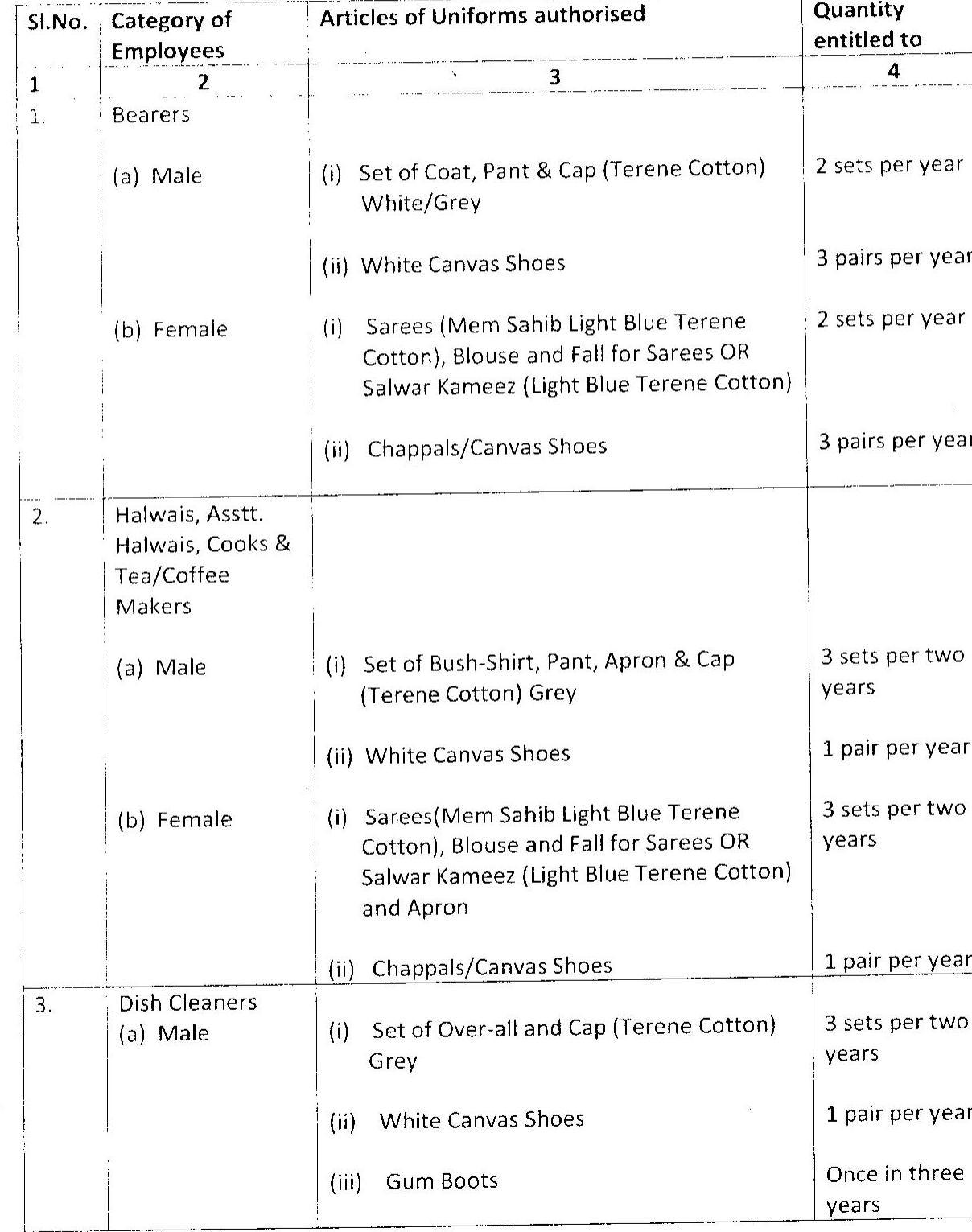
:2:
| (b) Female | (i) Sarees (Mem Sahib Light Blue Terene Cotton), Blouse & Fall for Sarees OR Salwar Kameez (Light Blue Terene Cotton) | 3 sets per two years | |
|---|---|---|---|
| (ii) Chappals/Canvas Shoes | 1 pair per year | ||
| (iii) Gum Boots | Once in three years | ||
| 4. | Sweepers | ||
| (a) Male | (i) Set of Bush-Shirt, Pant and Cap (Terene Cotton Khakhi) | 3 sets per two years | |
| (ii) White Canvas Shoes | 1 pair per year | ||
| (b) Female | (i) Sarees (Mem Sahib Light Blue Terene Cotton), Blouse & Fall for Sarees OR Salwar Kameez (Light Blue Terene Cotton) | 3 sets per two years | |
| (ii) Chappals/Canvas Shoes | 1 pair per year | ||
| 5. | For all categories mentioned at Serial Nos. 1 to 4 at Winter Stations | ||
| (a) Male | (i) Jerseys (ii) Woolen Socks | 2 in 3 years 2 pairs in 3 years | |
| (ii) Cardigans (ii) Woolen Socks | 2 in 3 years 2 pairs in 3 years | ||
| 6. | For the entitled categories | Turban for Sikh employees | 2 per year |
| 7. | (For Winter) | ||
| (a) Male | (i) Woolen Pant (White/Grey) | Once in 2 years | |
| (b) Female | (i) Woolen Salwar or appropriate woolens | Once in 2 years |